
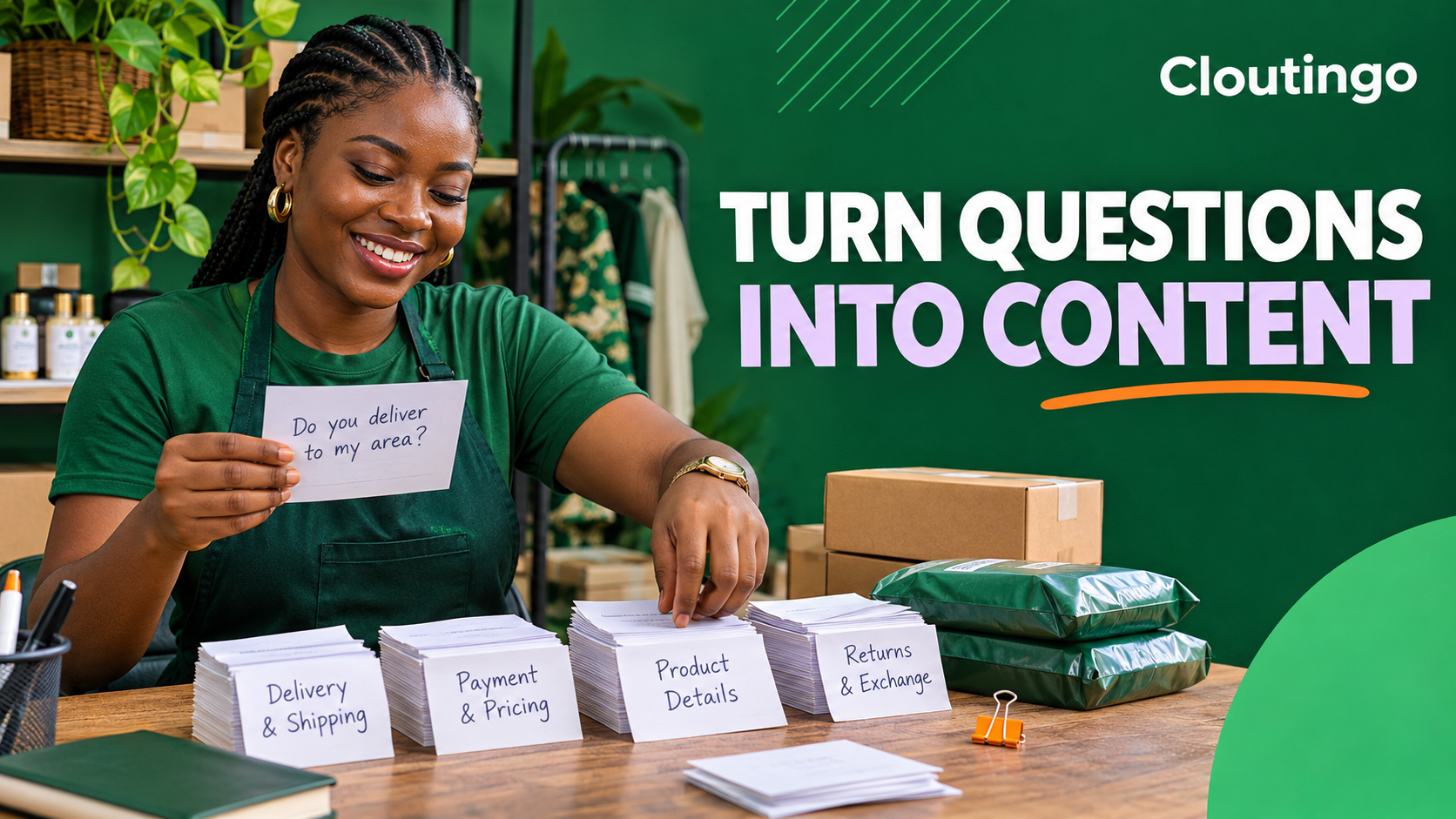
How Nigerian Online Sellers Can Turn Customer Questions Into Social Content
Customer questions can become a reliable social content bank when you collect them from real enquiries, remove private details, group repeated themes and write one approved answer for each theme. Start with questions that affect a buying decision or prevent product misuse. Then choose a format that makes the answer easier to understand.
This approach gives a Nigerian online seller useful topics without guessing what people care about. It also reveals where a product page, delivery policy or staff explanation needs improvement.
Collect questions without copying private conversations
Review the places where customers already ask for help: comments, direct messages, email, calls, support tickets, order notes and in-person conversations. Record the question in neutral language. Do not copy a customer's name, phone number, address, order number, payment details or private image into the content bank.
For example, change “Chika in Enugu asked whether order 2481 can arrive before Friday” to “How long does delivery to another state normally take?” The second version preserves the useful question without exposing a person's transaction.
Give staff one shared capture method. It can be a spreadsheet, form or simple document with these fields:
- Question in the customer's words, cleaned of private details
- Product or service involved
- Where the question appeared
- How often the team hears it
- Whether the answer changes by location, stock or date
- Person responsible for approving the answer
Group the questions by the decision they support
A long list becomes useful when similar questions are grouped. An online shop might use categories such as price and payment, delivery, size or compatibility, product care, returns and what happens after an order.

Grouping prevents the team from creating five near-identical posts about delivery while ignoring a high-risk care question. It also shows whether one master answer can support several pieces of content.
Prioritise with four practical signals
| Signal | What to ask | Why it matters |
|---|---|---|
| Frequency | How often does this appear? | Repeated confusion deserves a reusable answer |
| Decision impact | Does the answer help someone decide whether the item fits? | Useful content removes uncertainty without pressuring the buyer |
| Consequence | Could a wrong assumption cause damage, waste or a return? | Safety and correct use should not wait for a trend |
| Demonstration value | Would showing the answer be clearer than describing it? | A visible process can reduce ambiguity |
Do not rank a question only because it produced a lively comment thread. A less dramatic question about compatibility or cleaning may be more useful to buyers and may prevent avoidable problems.
Use website search data as a supporting source
If the business has a verified website in Google Search Console, the Performance report can show queries that led people to its pages. Google defines queries as the search terms that led to the site. Review relevant wording for additional question themes, but do not treat the report as a complete list.
Google explains that some queries are omitted to protect privacy and that the table does not show every row because of data limits. Customer conversations, site-search terms and staff notes therefore remain important alongside Search Console. See Google's query-data guidance for the current limitations.
Write one approved answer before choosing a format
Create a short source-of-truth answer for each priority question. Confirm current prices, delivery coverage, measurements, care instructions and return conditions with the person who owns that information. If an answer changes by product or location, state the condition instead of forcing one universal claim.
Only after approval should you select the content format:
- Use a simple image or text post for one clear fact.
- Use a step sequence when order matters.
- Use a comparison when two options are commonly confused.
- Use a demonstration when viewers need to see movement, scale or technique.
- Update the product page when the answer belongs permanently beside the item.
The last option is important. Social content should not become an excuse to leave essential product information missing from the buying page.
Give every entry a simple status such as collected, checking, approved, published or retired. “Checking” is useful when a staff member has found a valuable question but the answer depends on a supplier, courier or policy owner. Keeping that item out of production is better than filling the gap with an assumption.
Record the source used to approve technical or policy information. That source may be a current product manual, written delivery policy or authorised internal price list. When the source changes, the team can quickly identify which answers need another review.
Turn one question into one complete answer
Consider a hypothetical Nigerian appliance seller who repeatedly hears, “How do I clean this blender?” A useful piece of content can show the unplugged appliance, removable parts, safe washing method and the section that must remain dry. The seller should follow the manufacturer's instructions and avoid inventing a cleaning hack for entertainment.

The opening can repeat the question in plain language. The middle should show the answer without unnecessary suspense. The closing can point viewers to the written care guide or invite a product-specific follow-up. Avoid presenting generated comments, fabricated customer messages or staged testimonials as genuine evidence.
Maintain the bank as business information changes
Add an owner and review date to every approved answer. Delivery areas, stock, product versions, prices and return rules can change. Mark outdated answers for revision and remove content that could now mislead a customer.
Track whether the same question continues after the answer is published. If it does, the content may be hard to find, unclear or missing from the page where customers need it. Improve the explanation or placement instead of producing another near-duplicate post.
Use promotion only after the answer is accurate
A customer-question bank strengthens organic content because it starts with real uncertainty. It does not guarantee sales, and a popular answer is not proof that every viewer is ready to buy.
When a useful post is complete, review the currently available options on Cloutingo's services page. Check the required platform and link type, then read the terms. Individual services differ in audience, delivery and conditions, and purchased engagement should not be described as customer demand or organic endorsement.
If a listed service fits the post and campaign goal, you can open a Cloutingo account. Keep the content bank focused on truthful answers; promotion should support useful material, not turn an uncertain claim into a louder one.