
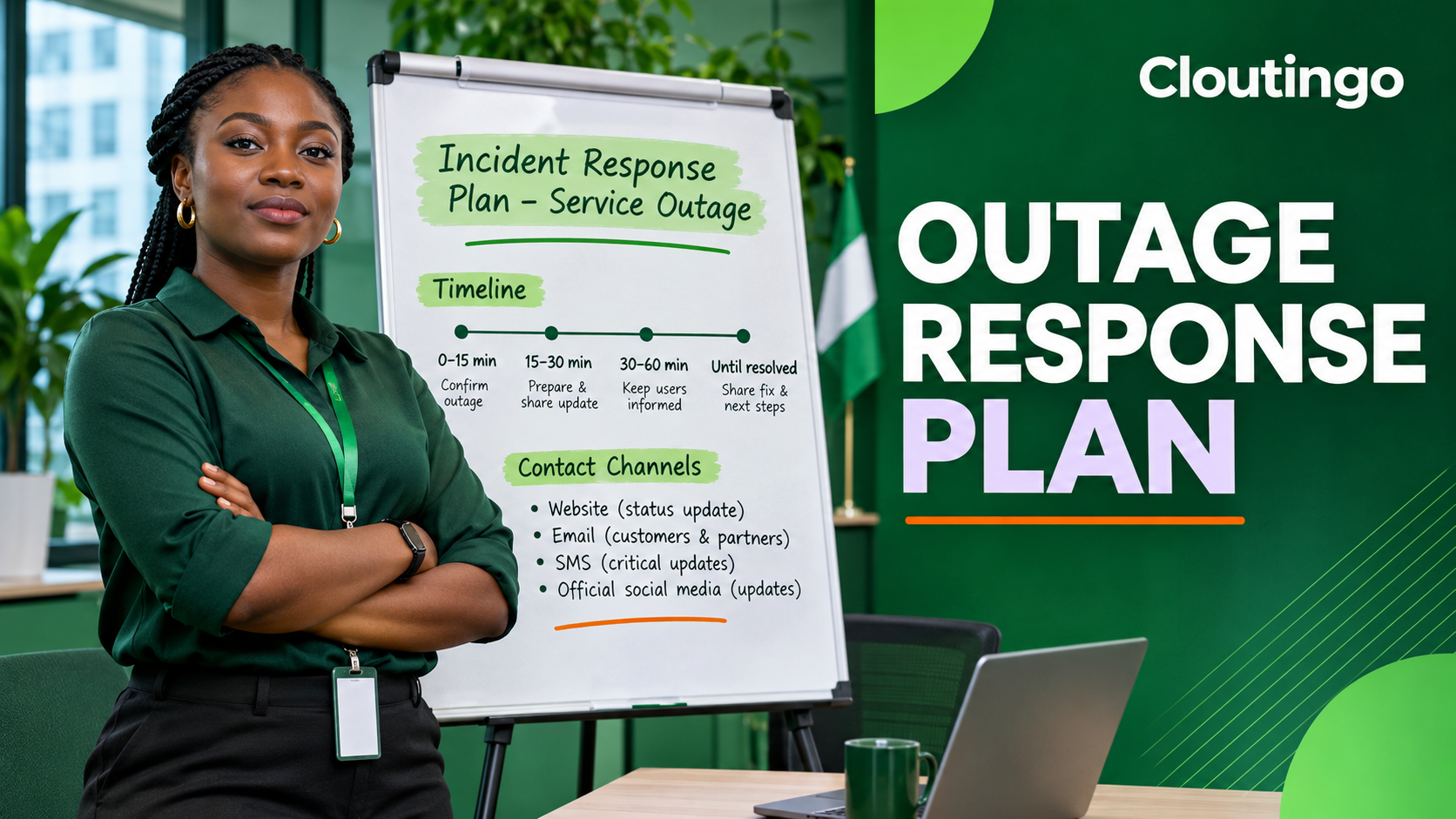
How Nigerian Businesses Can Communicate During a Social Media Outage
When a social platform appears to be down, first confirm the scope, appoint one incident owner and publish a short timestamped update. Say what is affected, what customers can still do, where the next verified update will appear and when you will review the situation again. Do not guess the cause or announce a recovery before your own team has tested it.
For a Nigerian business that receives orders or enquiries through social media, the communication plan matters as much as the technical check. Customers need a reliable route to your business while the usual channel is unavailable.
Separate a local fault from a platform outage
A failed post does not automatically mean the whole platform is down. The problem may affect one phone, one internet connection, one business account, a single feature or an entire service. Your first task is to narrow the scope without wasting the team's time.
Use a quick verification matrix:
| Check | What it helps you learn |
|---|---|
| Second device | Whether one device or app installation is the problem |
| Different network | Whether the office or mobile connection is involved |
| Another authorised account | Whether the incident is account-specific |
| Official status or known-issues page | Whether the provider has acknowledged a wider fault |
| Two customer reports | Whether the same function is failing outside your team |
For Meta business products, consult the official Meta Status page. YouTube maintains a Known Issues area. TikTok's Help Center provides troubleshooting and a route to report a problem. An official page may lag behind a new incident, so combine it with your own controlled checks.

Give one person control of incident updates
Choose an incident owner before pressure builds. That person gathers facts, approves public wording and records decisions. A technical colleague may run tests, while customer support handles replies, but only the owner should declare a change in status.
Define simple severity triggers. A minor problem may be a delayed analytics screen that does not stop customers from reaching you. A major incident may block your inbox, publishing, catalogue link or account access during an active sales period. Severity should reflect customer impact, not how frustrating the error feels internally.
Write a holding statement before you know the cause
A holding statement is a short first message that acknowledges a confirmed effect without pretending to know more. It should contain five facts:
- the time of the update and the timezone;
- the affected channel or function;
- what your team has confirmed;
- an alternative way to reach the business; and
- the time or condition for the next update.
For example, a hypothetical Lagos skincare seller might write: “Update, 10:20 a.m. WAT: We cannot currently receive new Instagram messages. Existing website orders are processing normally. Please use our website contact form or call the number on your receipt. We will post another update by 11:00 a.m. WAT.”
That message does not blame Instagram, promise a quick fix or tell customers to resend an order repeatedly. It separates what is known from what is still being checked.

Choose one source of truth and one backup route
Customers become confused when a website banner, email and team members give different instructions. Select one location as the authoritative update, such as a status page or website notice. Other channels should point to it when available.
Your backup contact route must be realistic for the business. It might be a website form, a phone line, email or a separate messaging service that your team already monitors. Do not announce a WhatsApp number that nobody can answer. Do not move card details or sensitive identity documents into an insecure channel just because the normal inbox is unavailable.
Government incident-planning guidance recommends defining communication triggers, escalation paths, templates and a single source of truth before an outage. The principle is useful even for a two-person business: decide who speaks, where the verified update lives and when the situation must be escalated.
Pause messages that could make the incident worse
Review scheduled posts and paid campaigns that send people to the affected channel. If an advertisement directs customers to a broken inbox, pause it when you have the access and authority to do so. Keep unrelated activity running only if it remains accurate and your team can support the response it creates.
Do not delete evidence in a rush. Save screenshots of error messages, note the time of each test and record which accounts or features were affected. This timeline helps the team reconcile missed enquiries and explain decisions later.
Update when the facts change
A fixed interval is useful for a severe incident, but do not post empty messages every few minutes. Each update should add a verified change, restate the available customer route or confirm that the investigation continues. Timestamp every public message so that an old screenshot cannot be mistaken for the latest instruction.
If there is no new information by the promised review time, say that clearly and give the next time. Silence after a deadline weakens confidence more than a factual “still investigating” note.
Test recovery before closing the incident
When the platform appears to return, test the exact customer journey that failed. Send a message, open the destination link, publish a controlled item if appropriate and confirm that another authorised team member can see the result. Check any queues for duplicated or missing enquiries.
The recovery notice should state what works, what remains affected and what customers should do about requests sent during the outage. Keep the alternative route available until the backlog is manageable. Then record what happened, which message reduced confusion and what contact route needs improvement.
Resume promotion with the correct destination
Cloutingo supports promotion across multiple social platforms, including Instagram, TikTok, YouTube, Facebook and WhatsApp. Promotion should resume only after your destination works and the selected service matches the campaign. Service audience, delivery and conditions differ, so read the description and our terms before ordering.
If everything is stable and the option is suitable, you can open a Cloutingo account and monitor the order in the panel. Purchased promotion does not repair a platform outage or guarantee sales. Its role begins after your customer route is functioning again.
A calm incident plan protects clarity. Verify the scope, appoint the owner, give customers a working alternative and close the incident only after testing the journey yourself.